2026-07-09
A Trustworthy AI Assistant for Wazuh: Design and a Self-Hosted PoC
Every SOC team I know is experimenting with the same idea: let analysts ask their SIEM questions in plain language. "How many authentication failures in the last 24 hours, and which users are targeted?" is a better interface than a query DSL, and large language models are clearly good enough to power it. The uncomfortable part is what happens next. A language model will answer that question fluently whether or not the answer is true, and in a security operations context a confident wrong number is worse than no number at all.
So the interesting engineering problem is not "can an AI answer questions about my alerts". It is "can I prove the answer is true, every time, structurally". This post walks through a proof of concept I designed and self-hosted that takes that question seriously: an AI assistant for Wazuh where veracity is a property of the architecture rather than a hope expressed in a system prompt. The whole thing runs on one Linux machine with Docker, and inference is pluggable, from Amazon Bedrock down to a fully air-gapped local model.
Updated 2026-07-17: the assistant now lives inside the Wazuh Dashboard itself, identity is verified against the indexer rather than a separate identity provider, and the two milestones this post originally listed as future work — a knowledge lane over the Wazuh docs, and human-approved actions — have shipped. The design principle underneath is unchanged; the sections below reflect the current build.
The core principle: the model never writes queries
The single decision everything else follows from is this: the language model never writes a datastore query and never computes a number. Instead, the assistant routes every question through a ladder of lanes, ordered by how verifiable the resulting answer is:
- Lane 0, no model at all. The question is embedded and matched against a curated corpus of bilingual exemplars. If the similarity clears a threshold (0.80), a pre-approved typed template executes directly and the answer is rendered by deterministic code. Roughly 40 milliseconds, zero model tokens.
- Lane 1, typed tools. The model chooses from a catalog of typed tools (
count_alerts,top_rules,auth_failures,alert_histogram, correlation helpers likealert_timelineandmitre_coverage, environment tools likelist_agentsandindex_health, and knowledge tools). Parameters are schema-validated. The model picks, it never composes. - Lane 2, a constrained query plan. For questions the catalog cannot express, the model emits a typed intermediate representation (a Query IR) instead of a raw query. The IR is validated against a field allowlist, compiled to OpenSearch DSL server-side, and can never contain scripts, regexes or wildcards because the compiler has no code path that emits them.
- Lane 3, free query generation, exists as a concept and stays off.
Two deterministic siblings sit next to lane 0, with no model in the loop either: a reference router that recognizes the shapes of recurring metadata questions ("what does rule 5710 mean", "what is data.srcip", "what can you do") and calls the exact tool for them, and playbooks that run curated multi-step investigations where each step passes the same checks as a single answer.
Every query that survives validation then passes through four veracity checks before its results reach the model:
- Mapping-aware validation: fields are checked against the live index mapping, not just the allowlist.
- Pre-execution dry-run: the datastore validates the compiled query before running it.
- Datastore-computed counts: every "how many" answer comes from
total_matchingor aggregation buckets that OpenSearch computed. The sampled alert list handed to the model is explicitly truncated, so counting it is impossible by construction. - Zero-hit differential diagnosis: when a query returns nothing, the pipeline probes the time window and each filter individually, so the answer can distinguish "verified: 214 documents in the window, none from agent db-99" from "the query was wrong".
Finally, every claim in a synthesized answer must cite an [alert:id], [agg:name] or [kb:id] identifier, and the service verifies each citation against what was actually retrieved. An invented citation surfaces as a correction event instead of a confident lie, and every answer carries a verifiability label stating which lane produced it and which checks ran.
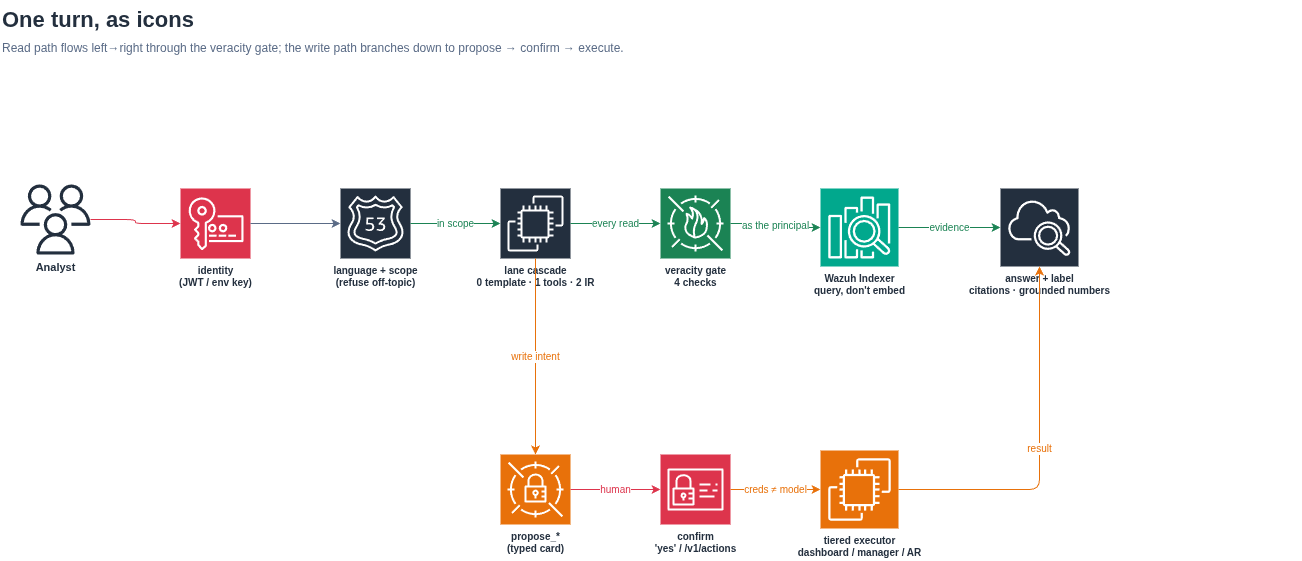
One turn end to end. The read path flows left to right through the lane cascade and the veracity gate; the write path branches down to propose, confirm and execute. Click any diagram for full resolution.
The architecture: the chat lives inside Wazuh
The most visible change since the first draft of this design is where the chat lives. It is no longer a separate app: the assistant is the OpenSearch Dashboards Assistant inside the Wazuh Dashboard, wired through ML Commons' HTTP connector to a headless gateway. Analysts get the chat where they already work, and the assistant inherits the dashboard's own session. The same gateway also answers through three other edges — n8n, a direct JSON API, and an MCP adapter for tools like Claude Desktop — so the hardened internals answer through every door.
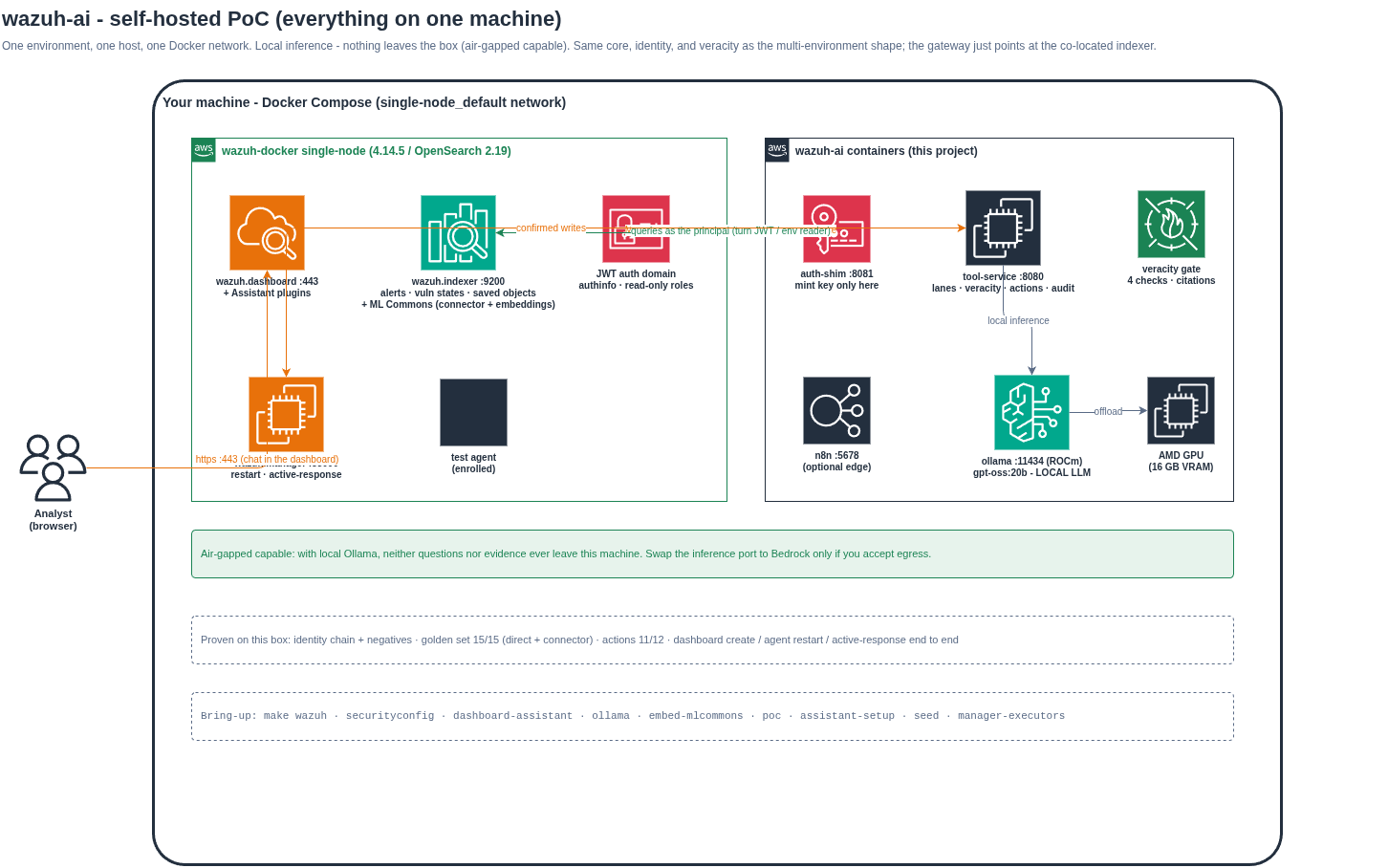
Everything except inference runs on one machine, and even inference can. With local Ollama, neither questions nor evidence ever leave the box.
The division of labor matters. The dashboard and the other edges are front doors and nothing more. The brain is a headless tool service (the gateway) that owns the entire agent loop, resolves which environment a request belongs to from a per-environment key, and exposes the read lanes, the veracity pipeline, the action layer and the audit trail. A per-tool HTTP surface executes exactly one validated tool with no model involved, which is what the deterministic evals drive.
The identity chain: the AI queries as you
The property I wanted to demonstrate is that the reasoning core can never forge an identity and holds no standing credential that reads telemetry. The chain has four hops and each hop verifies the previous one — and, importantly, it needs no external identity provider.
The analyst presents their existing Wazuh credentials. A dedicated auth-shim sidecar verifies those credentials against the environment's own indexer, by calling its authinfo endpoint, so identity is whatever the Wazuh security plugin already trusts — internal users, LDAP, or SSO — with nothing new to stand up. The shim confirms the user carries the analyst role and mints a turn credential: an RS256 JWT with a dual audience, a lifetime of at most ten minutes, and a tenant claim that comes from which environment's authinfo accepted the login rather than from anything in the request. The shim is the only container holding the signing key. The tool service verifies with the public key only, so a compromised reasoning core still cannot mint identities.
The fourth hop is my favorite part. The Wazuh indexer's security configuration gains a JWT auth domain trusting the same public key, so the tool service forwards the analyst's own token and the indexer resolves it to a read-only role scoped to alert indices. Telemetry queries execute as the logged-in analyst, and you can prove the ceiling directly, with no AI in the loop:
# allowed: read alerts as the analyst
curl -sk -H "Authorization: Bearer $TURN" \
  "https://localhost:9200/wazuh-alerts-*/_count" | jq

# denied: the analyst role cannot write, delete, or read other indices
curl -sk -X DELETE -H "Authorization: Bearer $TURN" \
  "https://localhost:9200/wazuh-alerts-4.x-2026.07.08"
The assistant can never show a user more than that token can query, because the assistant queries with that token. The negative cases fail closed: a token signed by any other key dies at signature verification, a token for another tenant is rejected and audited, and a user without the analyst role never receives a turn credential in the first place.
One port, three inference postures
Everything above sits on top of a single provider port. The loop speaks the Bedrock Converse shape internally, and one adapter translates to and from the OpenAI chat-completions dialect, tool calls included. Switching backends is an .env change plus a container recreate, and nothing above the port moves: same loop, same IR, same veracity checks, same identity chain, same audit.
That one seam yields three very different sovereignty postures:
| Backend | What crosses the machine boundary | When to use it |
|---|---|---|
| Amazon Bedrock | The question plus compacted evidence, under AWS no-retention and no-training terms | Production semantics, Guardrails attach per invocation |
| Ollama (local) | Nothing. Fully air-gapped | The strictest sovereignty demo, and free |
| Groq or another OpenAI-compatible cloud | Question plus evidence under that provider's terms | Lab experiments only |
The two model tiers (a small router model for cheap decisions, a larger analysis model for the investigation loop) can each bind to a different provider, so a local router with Bedrock analysis is a two-line configuration. For local serving, sparse mixture-of-experts models turned out to be the practical unlock: gpt-oss:20b gives big-model quality with about 3.6B active parameters and runs on a 16 GB machine, and qwen3:30b-a3b fits entirely in 24 GB of VRAM. At the extreme end I wired an experimental depth lane around AirLLM-style layer streaming, which really does run 70B-class models on a 4 GB GPU, at 0.07 to 0.7 tokens per second. That is not an interactive assistant and no configuration makes it one, so it is honestly positioned as a batch lane for one hard question overnight, never the chat path.
When the logs attack back
A SIEM assistant has an unusual threat model: its most dangerous input is not the user's question, it is the evidence. Alert bodies contain whatever an attacker managed to write into a log line, which means every piece of evidence the model reads is potentially an adversarial instruction. The pipeline treats it that way. The analyst's question passes a prompt-attack filter, retrieved evidence passes its own guardrail before the model sees it, the model's output passes a third check for secrets, PII and grounding, and citation verification then strips and flags any claim that references evidence that was never retrieved. What reaches the browser is sanitized Markdown: no HTML, no external links, no auto-loading images.
The honest defense, though, is structural: every tool the model can call is read-only and tenant-scoped, so even a perfectly successful injection has nothing dangerous to hijack. And because guardrail interventions and citation failures are audit events in the tenant's own indexer, an injection attempt becomes a SOC detection about the attacker. The assistant turns the attack into telemetry.
Recognition before reasoning
The optimization I like most needed no GPU at all. Analysts ask the same operational questions constantly, and those questions do not need a reasoning model. Lane 0 embeds each incoming question with a small local embedding model (bge-m3, which handles English and Spanish in one space), matches it against curated exemplars by cosine similarity, extracts slots like time windows and agent names with deterministic bilingual rules, and executes the matched template through the exact same veracity pipeline as every other lane. A hit answers in tens of milliseconds with zero model tokens, and on Bedrock that literally means the most frequent questions cost nothing. A miss escalates silently, so lane 0 can never break the assistant, only relieve it.
A single cosine threshold, though, will eventually fire the wrong template on a paraphrase with a negation in it, so a hit needs more than clearing 0.80. The near-miss band between 0.65 and 0.80 does not execute a template; instead the closest exemplar is injected as a transient few-shot hint for the model, after the cache-stable prompt prefix so it never poisons prompt caching. Recognition that is almost sure helps the model without pretending to be certain.
Next to it sits an evidence cache keyed on a hash of the canonical query plan, with time bounds floored to a TTL grid so that "last 24 hours" asked twice in the same minute is one query, not two. Cached answers disclose served_from_cache, because an assistant built on verifiability does not get to hide its shortcuts.
The knowledge lane, now shipped
Analysts do not only ask about telemetry. They also ask "what does rule 5710 mean" and "how do I enroll an agent", and those questions deserve the same veracity treatment as questions about alerts. So the assistant now has a knowledge lane over the official Wazuh documentation: a version-pinned corpus, ingested from the docs, chunked and embedded, that knowledge_search retrieves against — and every passage it returns is cited as [kb:id] and verified against what was actually retrieved, exactly like [alert:id]. This is the one place the system embeds anything, and it is deliberate: the only vector store in the whole design is over public reference content, never over a tenant's telemetry. Tenant data is queried, never embedded.
Alongside it, exact-lookup tools answer the metadata questions without any semantics at all: rule_reference for a rule ID or group, field_dictionary for a field name, mitre_lookup over a curated ATT&CK corpus baked into the image, and describe_capabilities for "what can you do". The reference router recognizes those shapes and calls the right tool directly — no model, no embedding — while genuinely open-ended "how do I / how should I remediate" questions fall through to the semantic docs lane. Recurring recognitions belong in a deterministic lane; only the open questions reach the model.
The model proposes, a human disposes
The other milestone that has shipped is write actions. Sooner or later every assistant gets asked to do something — restart that agent, suppress that noisy rule — and the rule that keeps it safe is structural, like everything else: the reasoning core holds zero credentials that can perform actions. When the model emits a propose_action, the gateway validates it against an allowlist, verifies the target independently by querying the indexer as the analyst, and renders a card of facts the model never wrote. Nothing executes until a human confirms, and execution runs under a per-tier least-privilege credential the model never holds — dashboard, manager, or active-response, each its own scoped identity. High-risk tiers demand the approver re-type the target. The operations half of this — capacity, the full action flow, audit and incident response — is its own post: Operating an AI Assistant in a SOC.
Proving it works instead of demoing it
Demos convince nobody, so the harness turns its claims into assertions. A seeder writes about two thousand synthetic alerts with a deterministic seed and records the exact ground truths into a file. A bilingual golden set of 32 evaluation cases then runs against the live stack through the full chain, from login to the final answer, asserting tool selection, ground-truth counts, zero-hit honesty, prompt-injection resistance, and the absence of unverified citations. It exits nonzero on any failure, which makes it a CI gate: prompt changes become physically unable to merge unevaluated. Separate suites drive the write-action paths (make evals-actions) and the dashboard connector edge (make evals-connector), and a unit suite that has grown from 26 to more than 150 tests covers the deterministic core — IR validation, DSL compilation, lane 0 slot extraction, cache keying and the citation checks.
The operational edges got the same treatment. Answers stream token by token, capacity is a bounded queue that rejects honestly instead of degrading silently, a kill switch turns every surface into a 503 when needed, and a Prometheus endpoint exposes turns by lane, tool outcomes and latency histograms.
Run it yourself
The complete harness is published in integrations/ai-assistant of my Wazuh repository, next to the other integrations and PoCs I have built around the platform. It is reproducible on any Linux machine with Docker and about 10 GB of free RAM (more if you want local inference):
cp .env.example .env         # pick an inference backend inside
make keys                    # per-tenant JWT signing keypair
make wazuh                   # official wazuh-docker single node, with certs
make securityconfig          # JWT auth domain, roles, and lab users
make dashboard-assistant     # bake the Assistant plugins into the dashboard image
make ollama embed-mlcommons  # optional: local model + in-cluster embeddings
make poc                     # the gateway, auth-shim, n8n
make assistant-setup         # register the ML Commons connector, model and chat agent
make seed                    # ~2000 synthetic alerts with known ground truths
make evals                   # the bilingual golden set, end to end
make test                    # the unit suite for the deterministic core
Then open https://localhost, click the Assistant icon, and ask "How many alerts in the last 24 hours?". If you already run Wazuh, there is no need to create one: two idempotent installers point the same assistant at a pre-existing deployment — install_gateway.sh stands up the gateway, local model and security objects, and install_dashboard_assistant.sh installs the Assistant plugins and wires ML Commons to it. A README walks every section of this post in runnable detail, from the Bedrock setup to the air-gapped variant. If you try it and want to compare notes, reach out.
From one machine to a fleet
The PoC mirrors the production design on purpose. The gateway, the identity chain and the veracity pipeline are identical whether they serve one environment or many; the only structural difference is the registry, which holds one entry here and N in production, each resolved by its own per-environment credential.
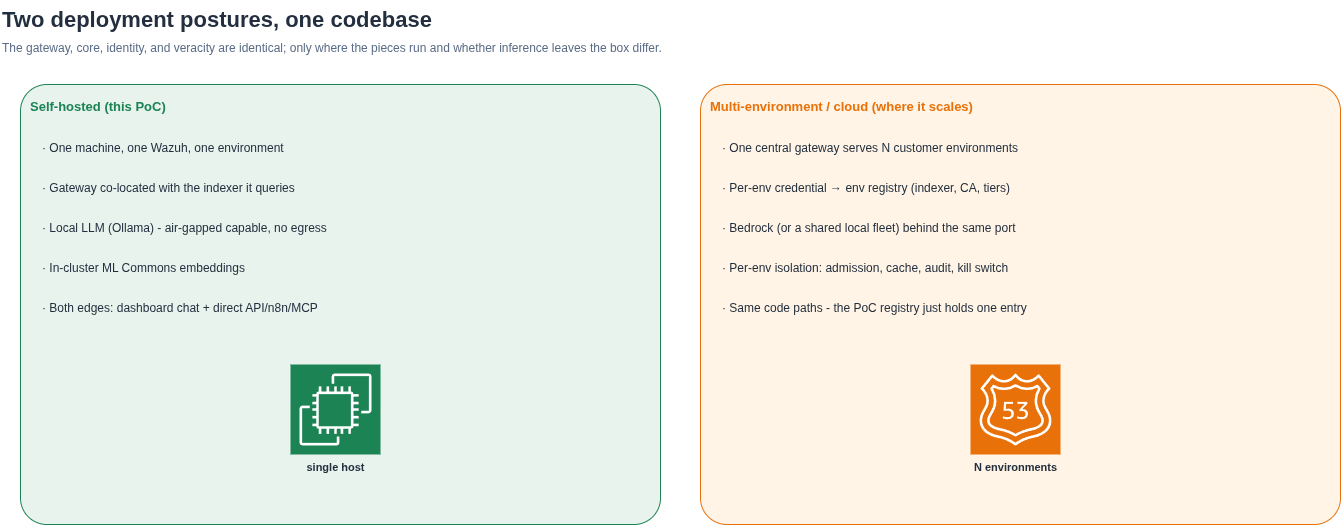
Same core, same identity, same checks. Only where the pieces run — and whether inference leaves the box — changes between the self-hosted PoC and the multi-environment cloud shape.
In production the harness unfolds into EKS with one namespace per environment behind a default-deny NetworkPolicy, and every environment gets its own IAM role (IRSA), its own Bedrock inference profile and guardrail, and its own KMS key. The AI path never touches the internet, since Bedrock, STS, Secrets Manager and logging are all reached through VPC interface endpoints, and audit lands both in the environment's own indexer and in an Object Lock S3 bucket. The only shared hop on the data path is Bedrock's stateless model fleet, and that is exactly the hop with no retention.
What I'd harden next
A PoC earns the right to be taken seriously by knowing its own gaps, so here is my list, in order:
- The evidence cache must key on identity, not just on the query plan. Two analysts with different index permissions must never share a cache entry, so the effective role set belongs in the cache key. It is the kind of bug that only exists because the cache works.
- Turn JWTs need a revocation path. Ten minutes is short, but a kill switch should not have to wait for expiry; a small in-memory denylist of
jtivalues closes that window. - Zero-hit diagnosis should pay for itself under admission control. The differential probes multiply indexer queries on every zero-hit turn; they should run under the same semaphore as everything else, tagged in the audit record.
- Local models deserve constrained decoding. Grammar-constrained output for the Query IR turns parse-and-retry loops into first-try validity, which on a 20B local model is real latency back.
- Escalation drift should page someone. The per-lane metrics already exist; an alert on a rising lane-2 rate catches a prompt regression before anyone notices the answers got slower and more expensive.
- The Bedrock fidelity leg needs proving. Local inference is validated end to end; the cloud posture, including prompt-cache token accounting, is the one backend I have not yet exercised against the full golden set.
None of these change the architecture. That is the point of getting the structure right first: everything on the list is a hardening pass inside a seam that already exists.
The two additions I originally flagged as milestones — a knowledge lane over the Wazuh docs, and human-approved actions — are the two sections above, now shipped and live-validated. Multi-turn conversations survive across a turn now too, so follow-ups that reference earlier evidence stay verifiable. What remains genuinely open, rather than merely unbuilt, is the multi-environment cross-tenant isolation suite: the shape is there and the registry is real, but asserting isolation across live tenants is the work I set aside to keep the self-hosted story sharp.
What I took away
Three lessons survived contact with the implementation. First, veracity is structural or it is nothing: allowlists, server-side compilation, datastore-computed counts and verified citations do more for trust than any amount of prompt engineering, because they hold even when the model is wrong. Second, identity is the feature nobody demos and everybody needs. Queries-as-user through a JWT auth domain means the AI inherits exactly the permissions of the person asking, and that single property answers most of the hard multi-tenancy questions before they are asked. And third, honest engineering beats impressive engineering. The layer-streaming depth lane is technically the flashiest part of the stack, and the most valuable thing I did with it was measure it, state that 0.2 tokens per second is not a chat experience, and confine it to the lane where it genuinely helps.
A SIEM assistant does not earn trust by sounding right. It earns trust by being checkable, and that is an architecture decision.
This is the design half of the story. The operations half - capacity without a load balancer, human-approved actions, the audit map and the incident-response playbook - is in Operating an AI Assistant in a SOC.